

Heart rate variability (HRV), sometimes also referred to as heart rate variability, forms the basis of every HRV analysis and refers to the subtle fluctuations in the intervals between successive heartbeats. These variations are controlled by the autonomic nervous system and are normally imperceptible when simply feeling one’s pulse. HRV analyses make these fluctuations measurable and provide valuable insights into the balance between the sympathetic and parasympathetic divisions of the autonomic nervous system. A high HRV is generally considered a sign of the body’s good adaptability—people with high HRV are often less stressed and healthier overall. Conversely, a consistently low HRV is associated with low stress resilience and an increased risk of future health problems. In this article, we explain how HRV analysis works, why it is gaining importance in medicine and fitness, and what HRV monitors and heart rate variability devices are available to accurately measure heart rate variability.
What is HRV, and what does an HRV analysis reveal?
Heart rate variability describes the constant fluctuations in the time intervals between heartbeats—essentially, the irregularity of the heart rhythm within normal limits. This seemingly chaotic pattern is actually an indicator of how flexibly our cardiovascular system responds to various stimuli. HRV is primarily controlled by the interaction between the sympathetic (“fight or flight”) and parasympathetic (“rest and digest”) nervous systems. When the sympathetic nervous system is active (e.g., during stress), the heart rate increases and HRV tends to decrease; when the parasympathetic nervous system predominates (e.g., during relaxation), the heart rate decreases and HRV increases.
Heart Rate Variability Analysis: From Measurement to Interpretation
An HRV analysis uses these relationships to assess the state of the body’s autonomic regulation. Measuring heart rate variability provides meaningful insights into the interaction between the sympathetic and parasympathetic nervous systems, as well as the overall state of the nervous system. Thus, a heart rate variability analysis can indicate at an early stage whether someone is experiencing chronic stress or whether the autonomic nervous system is in balance. It is important to note that HRV is highly individual and subject to natural fluctuations. For this reason, in practice, changes over time and deviations from a person’s baseline level are often examined. In addition, scientifically published reference and normative values exist for various age groups and populations. As a general rule, higher HRV is usually associated with good adaptability of the autonomic nervous system,

Why Is HRV Analysis Important? Applications in Medicine and Sports
In recent years, HRV analysis has established itself as a useful tool for assessing stress levels, health status, and performance. HRV measurements are used both as markers of cardiovascular health and for risk assessment, as well as to guide training and recovery in sports. In the medical field, particularly in stress medicine and preventive medicine, HRV analysis helps identify imbalances in the autonomic nervous system at an early stage. This is relevant, for example, in stress-related conditions such as burnout or sleep disorders, where low HRV may indicate chronic overactivation of the stress response system. In addition to HRV analysis, many users in such cases rely on targeted support, such as the STRESSRESIST supplement, to strengthen the body’s own stress resistance. In cardiology, on the other hand, HRV analysis enables a nuanced assessment of the effects of stress on the cardiovascular system. In patients with chronic conditions such as diabetes or high blood pressure, HRV is also used to monitor disease progression and evaluate the success of treatments.
Measuring Heart Rate Variability in Athletes
HRV measurements are also becoming increasingly important in competitive sports and training management. Athletes and coaches use HRV to assess recovery status and adjust training plans. A reduced HRV may indicate, for example, that the body is still fatigued or stressed, while a high HRV typically occurs after sufficient recovery. Overall, HRV provides an objective view of the autonomic nervous system. It makes invisible stress visible and helps doctors, therapists, and sports scientists provide personalized recommendations for stress management, lifestyle changes, or training programs.
The Process of an HRV Measurement in Practice
Measuring heart rate variability requires sensitive sensors, since the time intervals between heartbeats are sometimes only a few milliseconds. Modern technology now makes it possible to measure HRV.
In a doctor’s office or therapist’s practice, a short-term HRV measurement is usually conducted as follows:
- Preparation: The patient should rest for about ten minutes before the measurement is taken. During this time, the pulse returns to normal after exertion or excitement. Personal information (age, gender, etc.) is entered into the system, as it may be relevant to the evaluation.
- Applying the sensor: An ECG-accurate heart rate variability monitor is prepared, often in the form of an elastic chest strap with electrodes. The electrodes on the strap are moistened, and the strap is placed around the chest to record the heart’s electrical signals.
- Measurement Phase 1 (Rest): The first measurement is usually taken while the patient is sitting at rest and breathing normally. The patient continues to breathe normally while the device records the heartbeat for several minutes (often about seven minutes).
- Measurement Phase 2 (Breathing Test): A second measurement is then performed while the patient breathes slowly and in a controlled manner. The patient follows a specified breathing rhythm (e.g., six breaths per minute). This so-called resonance breathing stimulates the parasympathetic nervous system. The test measures how much HRV increases during deep breathing—an important indicator of parasympathetic regulatory capacity.
Interpretation and Evaluation of HRV Analysis
The results are available immediately after the measurement. If necessary, changes between different measurement time points can be examined. The heart rate variability analysis generates clear diagrams (e.g. , rhythmogram, histogram, scatter plot). The doctor or therapist discusses the results with the patient to explain the individual state of the autonomic nervous system. Thanks to traffic-light colors and clear graphics, it is often possible to see at a glance whether “everything is in the green zone” or whether there are any imbalances. The entire examination takes about 10–15 minutes.

Measuring Heart Rate Variability: Professional Systems for Doctors and Therapists
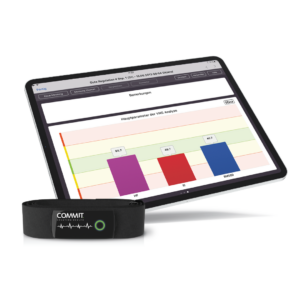
While fitness trackers can provide initial insights into HRV, medical professionals rely on professional HRV systems for precise analysis. Such systems combine high-quality sensors with specialized software and are often designed for use in medical practices and hospitals. One example is the VNS analysis we use (VNS stands for vegetative nervous system). This heart rate variability monitor measures HRV using a chest ECG lead and enables precise measurement of the time intervals between heartbeats. Unlike simple consumer-grade HRV monitors, professional systems often take into account not only the standard HRV metrics (such as SDNN for overall variability or RMSSD as a measure of parasympathetic activity) but also advanced parameters. The VNS analysis, for example, additionally evaluates specific markers of autonomic regulation, including the stress index (according to Baevsky, as an indicator of sympathetic activity) and the nonlinear alpha-1 value (DFA-α1), which reflects the complexity of HRV. This combination provides a highly nuanced view of the balance between the sympathetic and parasympathetic nervous systems, enabling a precise assessment of regulatory capacity.
HRV Monitors in Everyday Clinical Practice
Another advantage of modern HRV systems is their user-friendliness and integration into daily practice. For example, the VNS analysis runs on a tablet and generates reports automatically. After each measurement, the software creates a PDF containing the most important results and graphs, which can be sent directly via email or printed out. For patients, there are easy-to-understand visualizations (e.g., traffic-light graphics for stress/relaxation), while therapists have access to detailed views with numerical values. Some heart rate variability monitors also offer biofeedback functions: During the measurement, the patient can, for example, stimulate their parasympathetic nervous system through guided breathing exercises, which not only influences the measurement but also has a learning effect. For daily practice at home, the Vagusvit® Breathing Trainer app is a useful supplement; it supports the user in activating the parasympathetic nervous system with preset breathing rhythms. Through this integrated biofeedback, the patient learns how slow breathing or relaxation directly affects their HRV—a valuable experience that can motivate them to improve their stress management.
Measuring Heart Rate Variability to Monitor Treatment
Our VNS analysis is an example of a comprehensive HRV system that combines all these aspects. It was developed specifically for physicians and therapists and has become the standard test in regulatory medicine. Through regular HRV analyses, practitioners can objectively track whether, for example, stress management programs or therapies are effective. If HRV increases over time, that is a positive sign. At the same time, such systems enable reimbursement (depending on the country and health insurance provider), as HRV measurements may be billable in the context of certain diagnoses. In this way, professional HRV systems create added value both in terms of the medical quality of care and economically for the practice.

How HRV Analysis Can Benefit Your Health
HRV analysis offers an ingeniously simple way to visualize the interaction between the heart and the nervous system. From doctors and therapists to trainers, more and more professionals are using heart rate variability as an objective parameter to holistically assess health and performance. Modern HRV systems make the measurement precise, fast, and patient-friendly. For medical professionals, HRV analysis thus offers a valuable glimpse “behind the pulse”; for patients, it provides a motivating visualization of their inner balance. By learning to understand our HRV, we can take steps to restore harmony between body and mind. Measuring HRV means staying one step ahead of health issues, as variability often signals problems even before symptoms appear. It’s no wonder, then, that HRV analysis is playing an increasingly important role in preventive medicine, cardiology, and sports science.
FAQ: Frequently Asked Questions About HRV Analysis
- What does heart rate variability tell us about our health?
Put simply, HRV reflects how flexible and balanced the autonomic nervous system is. High HRV is associated with good cardiovascular health, resilience, and inner balance. Low HRV, on the other hand, is often seen in cases of prolonged stress, fatigue, or chronic illness; the body is less adaptable. However, context is always important: A one-time low HRV (e.g., after intense exercise or an illness) is not necessarily cause for concern. Only when HRV is chronically reduced or unusually low for the individual should one look for underlying causes. Doctors therefore use HRV as an additional tool to assess, for example, stress levels, the risk of heart disease, or the success of interventions—always in combination with other findings.
- What’s the best way to measure HRV, and are fitness trackers sufficient?
For a truly precise measurement of heart rate variability, an ECG-based device is recommended. Chest straps with an ECG sensor offer good quality. Wearables such as smartwatches and fitness trackers use optical sensors; they can show HRV trends but are nowhere near as sensitive—especially during exercise, they often provide inaccurate data. Especially when important decisions or diagnoses depend on it, you should rely on medical-grade HRV measurement devices. These provide greater measurement accuracy and often include analysis based on clinical standards. In short: Fitness trackers are sufficient for a general overview, but for in-depth analysis, you should rely on ECG-accurate HRV systems.
- Can HRV be improved through exercise or lifestyle changes?
Yes, heart rate variability is not a fixed value; it responds to long-term lifestyle changes. Regular physical activity and healthy cardiovascular exercise can increase HRV over time as the heart becomes more efficient and adaptable. Stress reduction and mental health also play a role: Chronic stress or anxiety lower HRV, while relaxation techniques, meditation, or yoga can help increase it. A balanced diet and adequate sleep also have a positive effect. In addition, there is targeted HRV biofeedback training: In this method, you practice increasing HRV through guided, slow breathing exercises. Studies show that such breathing training via biofeedback can not only improve HRV but also reduce stress and anxiety. Patience is key: improvements often become apparent only after weeks or months of consistent lifestyle changes. Since HRV is influenced by many factors (age, genetics, daily form, etc.), progress should always be assessed over a longer period of time. A rising average HRV or a smaller decrease in HRV under stress is a good indicator that you’re on the right track.
- When is an HRV measurement only of limited value?
The interpretive value of an HRV measurement may be limited in certain cases of cardiac arrhythmia. This is particularly true for atrial fibrillation or atrial flutter, since the variations in RR intervals in these cases are not exclusively influenced by the autonomic nervous system. Other factors, such as movement during the measurement, acute stress, or a lack of standardization in measurement conditions, can also influence the results. In general, HRV analysis is used to assess the regulatory and adaptive processes of the autonomic nervous system and should always be considered within the broader context.